
Our Clan
Wear it with pride
The crest, the motto, the tartans and the tunes that say “MacLachlan” at any gathering.
Background photo: Close-up of MacLachlan Modern tartan with a silver crest badge
The crest badge
A castle on a rock
The MacLachlan crest is blazoned: Out of a crest coronet, a castle set upon a rock, all proper. A golden coronet of strawberry leaves cradles a rock, and on it stands a castle of three towers.
By tradition, the three towers stand for the three royal lines the chiefs descend from: the Dalriadic kings of Ireland, the Celtic kings of Scotland, and the Norse kings of the Hebrides. The rock recalls the Stone of Destiny, on which the kings of Dál Riata were crowned at Dunadd, once MacLachlan land.
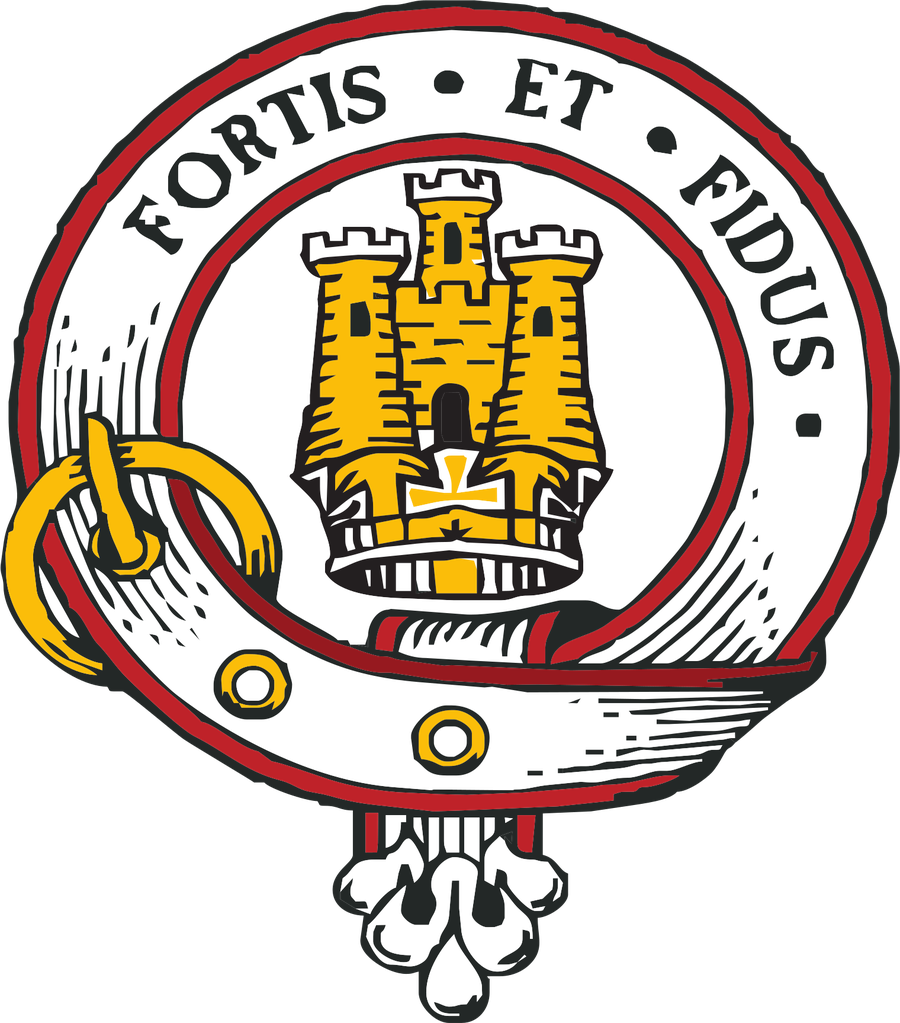
Can I wear it? Yes. The crest belongs to the Chief, but any clansman or clanswoman may wear the crest badge: the crest encircled by a strap and buckle bearing the motto. It shows you are a follower of the Chief.
Symbols of the clan
Motto
Fortis et Fidus
“Strong and Faithful.” Two words that sum up a thousand years of clan history.
War cry
“Life or Death”
The charge cry of the MacLachlan and MacLean regiment at Culloden in 1746, adopted ever since as the clan’s war cry. Shout it proudly at the Parade of Tartans.
In Gaelic
MacLachlainn
The Gaelic form of the name, “son of Lachlan.” Lachlann means “land of lochs.”
Plant badge
Rowan
The rowan, or mountain ash, was thought the strongest charm against evil, so it was planted beside homes and castles. Clansfolk wore a sprig pinned behind the crest badge on their bonnet.
Plant badge
Lesser periwinkle
The clan’s second plant badge, once called the “sorcerer’s violet,” was also a charm against evil spirits. It makes a fine evergreen ground cover with blue flowers in spring.
Pipe tune
Moladh Màiri
“In Praise of Mary,” a piobaireachd (classical pipe tune) also known as MacLachlan’s March. Tradition says a piper composed it for the chief’s daughter who gave him the skin for a new bag for his pipes.
[Audio block: add a recording of Moladh Màiri]
The MacLachlan tartans
MacLachlans have several tartans to choose from. Any of them is correct to wear; choose the one you like best. For official thread counts, consult the Scottish Register of Tartans.
MacLachlan (Modern)
The familiar red, blue and black sett, first described in Logan’s The Scottish Gael (1831). A red-and-blue variation of the Black Watch pattern.
MacLachlan Ancient
The same sett in softer, “ancient” colours, meant to evoke natural dyes. The shading style dates from around the 1950s.
MacLachlan Weathered
The same sett again, in colours imagining cloth aged by weather and peat: deep red, slate grey and olive.
Old MacLachlan (Pattern 66)
A simple red-and-green check listed as “No. 66” or “MacLachlan” by Wilsons of Bannockburn in 1819. Madam Marjorie later released it to the Moncreiffes, but MacLachlans may still wear it.
MacLachlan Dress
First published in the Vestiarium Scoticum of 1842. [Photo to come.]
MacLachlan Hunting
Recorded in collections from about 1790 and 1816 under the name MacLachlan. [Photo to come.]
Tartan questions
-
Clan tartans are worn by members of the clan and their families. If you are of MacLachlan, Gilchrist or MacEwen descent, or married into the family, the tartan is yours.
-
Most Highland outfitters and weavers carry MacLachlan Modern and Ancient. Ask for “MacLachlan” by name. Members can also find polos and gifts in our Shop.
-
They are usually the same pattern (sett) woven in different colour shades, not different ages of tartan.
Wear the tartan at the Parade.
Members march together under the MacLachlan banner at games across North America.